Table of contents
Will image generators make graphic designers obsolete, or will they simply change what “design” means in an era of faster production and tighter budgets? In 2024 and 2025, brands, agencies, and in-house teams have accelerated their adoption of generative tools, pushed by new platform features, cheaper compute, and the constant pressure to publish more content. Yet the day-to-day reality in professional studios looks less like replacement and more like reconfiguration, because quality, originality, and legal defensibility still hinge on human judgment.
AI images are everywhere, but so are the limits
The pace of adoption is no longer anecdotal, it is measurable. Adobe reported that Firefly surpassed 10 billion generated assets by 2024, a scale that signals routine use across marketing pipelines rather than occasional experimentation. Meanwhile, the broader market is expanding quickly: multiple industry forecasts put the generative AI segment on a steep growth curve through the end of the decade, with widely cited projections measured in the tens of billions of dollars by 2030. In parallel, the number of consumer-facing outputs has exploded, from social ads and thumbnails to concept boards and quick mockups, because the marginal cost of “another version” has collapsed.
But ubiquity does not equal readiness for professional replacement. The most common failure modes show up in places clients actually care about: consistency, controllability, and intent. A campaign needs a coherent visual language across dozens of touchpoints, not a handful of pretty one-offs, and image generators can still drift in style, lighting, anatomy, typography, and brand specificity when you ask for variations. Even when models produce something striking, the path from “cool” to “usable” often includes rounds of manual fixes: cleaning edges, correcting hands, aligning grid systems, reworking layouts, or rebuilding type entirely. For many teams, AI reduces the time spent on ideation and rough production, yet it does not eliminate the craft of turning visuals into a reliable system.
The hidden bottleneck: brand consistency at scale
Here is the uncomfortable question executives keep rediscovering: can your AI output stay on-brand for months, across channels, and under real deadlines? Designers are not hired only to make images, they are hired to make decisions that hold together, from hierarchy and color contrast to tone, inclusivity, and accessibility. A brand system is a living organism, shaped by audience feedback and competitive context, and human designers translate that complexity into repeatable rules, templates, and exceptions.
Generative tools can help, but they also introduce a new layer of governance. Someone needs to define prompt libraries, set style references, approve “safe” aesthetic ranges, and establish what cannot be generated at all, for example anything resembling a competitor’s trade dress, a celebrity likeness, or a recognizable trademarked object. The more a brand cares about distinctiveness, the more it relies on guardrails, and those guardrails themselves require skilled stewardship. This is one reason many organizations are splitting the role: AI accelerates exploration and prototyping, while designers and creative directors focus on system integrity, final art direction, and the ability to defend choices when a campaign underperforms.
There is also a practical production problem that rarely appears in demos: real-world assets are messy. Designers juggle color profiles, print specs, packaging constraints, localization, responsive breakpoints, and the quirks of each platform. An AI image can be a starting point, yet it must still survive the gauntlet of production requirements. When deadlines tighten, the risk is not that designers disappear, it is that teams underestimate the coordination work that designers quietly handle, and then pay for it later in rework.
Copyright, consent, and liability are not side issues
Replacement arguments often focus on speed and cost, but legal defensibility can be the real deciding factor, especially for larger advertisers. The generative AI ecosystem is still navigating disputes around training data, similarity, and authorship, and while policies differ across tools and jurisdictions, the overarching reality is straightforward: if a company cannot confidently explain where an image came from, it may hesitate to put that image on a billboard, a product box, or a global campaign landing page.
In the United States, the Copyright Office has reiterated that works containing AI-generated material may face limits on copyright protection when human authorship is not sufficiently present, a detail that matters when brands want exclusive control over key visuals. In Europe and the UK, the regulatory conversation continues to evolve, and companies operating across markets must reconcile different expectations on transparency and data use. On top of that, many marketing teams now treat reputational risk as seriously as legal risk, because audiences react quickly to anything that looks like scraping, imitation, or uncredited appropriation.
This is where professional designers still provide a form of insurance. They document process, maintain source files, ensure releases are in place for photography or illustration, and can articulate how a final composition was built. AI can be part of that process, but organizations increasingly want traceability: what references were used, what assets are licensed, what edits were made, and who approved the final. If you are exploring tooling in that direction, you can have a peek at this website to see how platforms are framing AI-assisted creation within broader workflows, rather than as a one-click replacement for creative accountability.
Designers won’t vanish, but the job is changing fast
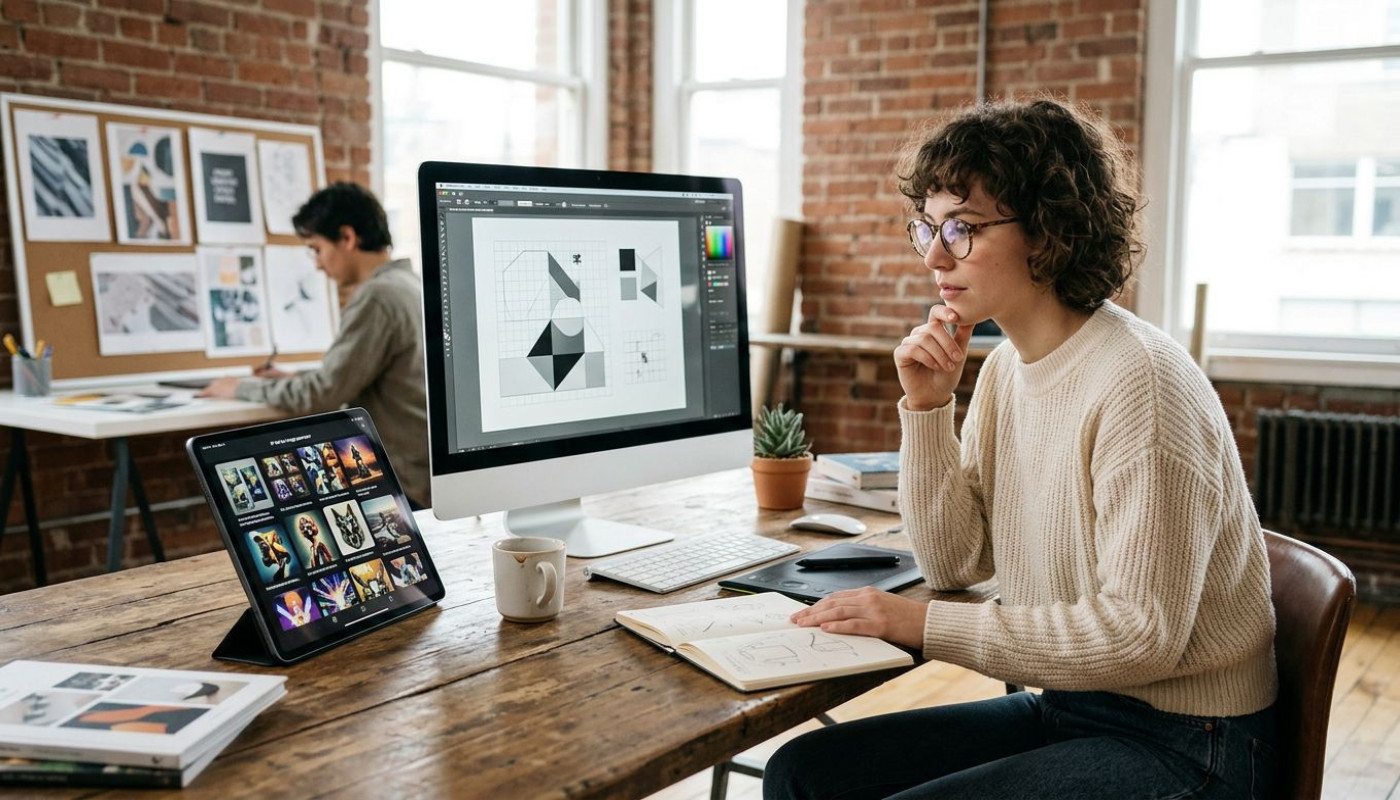
The most credible future is not “AI versus designers”, it is designers operating at a higher altitude, with AI doing more of the rough labor. In many studios, the value has already shifted from manual execution toward orchestration: building mood boards in minutes, generating multiple directions for stakeholder alignment, then refining one path with human taste and technical precision. This can compress timelines, but it also raises the bar, because clients will expect more options, faster iteration, and stronger rationales for why one direction wins.
The skill set is evolving accordingly. Prompting, reference management, and tool fluency are becoming baseline expectations, much like knowing Photoshop became non-negotiable in earlier eras, yet the differentiator remains the human layer: framing the problem, understanding the audience, editing ruthlessly, and producing a coherent system that survives scrutiny. Designers who thrive will be those who can art-direct AI outputs the way they art-direct photographers or illustrators, while also protecting brand distinctiveness in a world where “pretty” is cheap.
For employers, the smarter question is not whether to replace a designer, but which parts of the pipeline should be automated, and what new roles are needed to prevent chaos. Some teams will need fewer junior production hours and more creative direction, others will invest in template engineering, asset governance, and compliance review. In practice, many organizations will land on a hybrid model: AI for speed, humans for meaning, and a clear policy that defines what can ship. That policy, more than the model’s raw capability, may determine whether AI becomes a cost-saver or a liability.
Planning your next creative cycle
Set a budget for experimentation, reserve time for governance, and document what is permitted before a campaign starts. If you rely on paid media or print, prioritize traceable assets and approvals. Where available, use training, internal guidelines, and relevant support programs for digital upskilling. The teams that plan now will iterate faster, and publish with confidence.
Similar articles


